
Academics
Westbridge strives to empower students to become reflective learners, to realize their strengths, and to embrace challenges as learning experiences.
Academic subjects are taught and interpreted from a biblical perspective.
Executive function strategies are taught and reinforced in all subjects.
Lessons are multi-modal and interactive. Research indicates that when multiple senses are stimulated at once, students learn better.
Placement is skill-based, not grade-based.
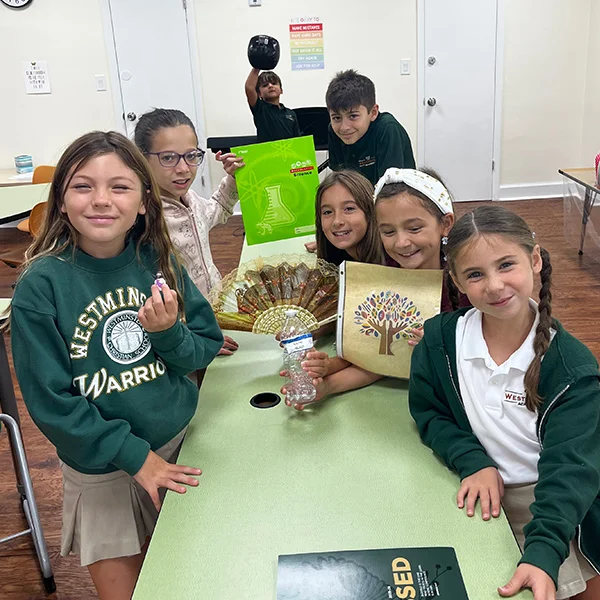
Reading
Orton-Gillingham is an evidence-based Structured Literacy Approach that uses research from the Science of Reading (SOR), a vast, interdisciplinary body of scientifically based research about reading and issues related to reading and writing. Structured Literacy provides content, principles, and strategies that are beneficial for all students, but vital for those with dyslexia.
Research-based strategies that promote student growth in language and literacy
Explicit vocabulary instruction, comprehension strategy instruction, and opportunities for discussion of text meaning and interpretation
Students’ interests are incorporated to increase motivation and engagement in literacy

Math
Math concepts are taught through a hands-on approach with the use of manipulatives to go beyond memorization and to develop a deeper mathematical understanding.
A student-paced mastery approach emphasizes problem-solving and strategy development, moving from the concrete to the abstract.
Students build expressive language during math by comparing ideas, justifying methods, and articulating thinking.

Makerspace
The makerspace is a space for creativity and exploration.
Students can create, design, and explore using tools and resources such as 3D printers, 3D pens, and sewing machines.
Science, technology, engineering, art, and math (STEAM) are incorporated in hands-on robot building, coding, art projects, and engineering experiences.
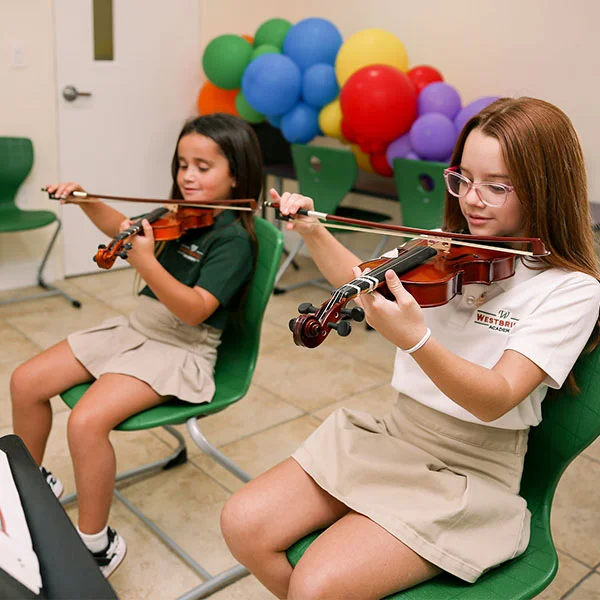
Music
Music has cognitive and social-emotional benefits, and students will develop knowledge of and appreciation for a wide range of musical styles.
Students will experience music in many ways: singing, playing instruments, reading, writing, improvising, and creating.
Multi-modal Instruction
Our approach incorporates activities that engage multiple senses (visual, auditory, and kinesthetic) to reinforce learning and to address the child’s language-based learning disability.
01
FRONTAL LOBE
- Whole Body Movement
- Language Expressive
- Social Emotions
- Cognitive
03
Temporal LOBE
- Sensory
- Congnitive
- Language Receptive

01
FRONTAL LOBE
- Whole Body Movement
- Language Expressive
- Social Emotions
- Cognitive
02
Parietal Lobe
- Whole Body Movement
- Fine Motor Movements
- Sensory
03
Temporal LOBE
- Sensory
- Congnitive
- Language Receptive
02
Parietal Lobe
- Whole Body Movement
- Fine Motor Movements
- Sensory
04
Cerebellum
- Whole Body Movement
- Fine Motor Movement
- Language Expressive
05
Occipital Lobe
- Sensory